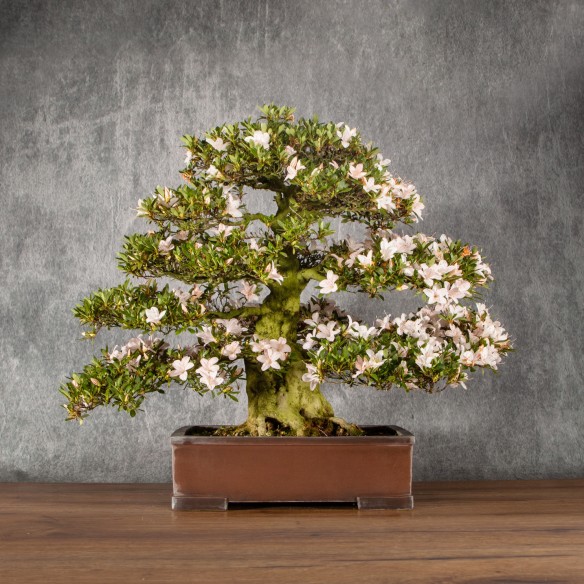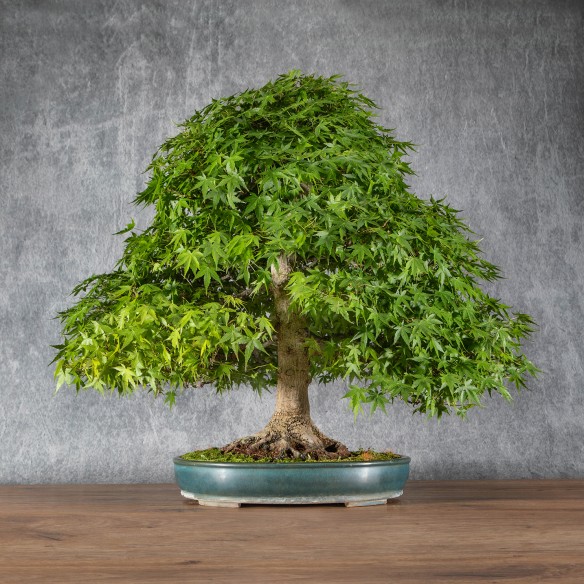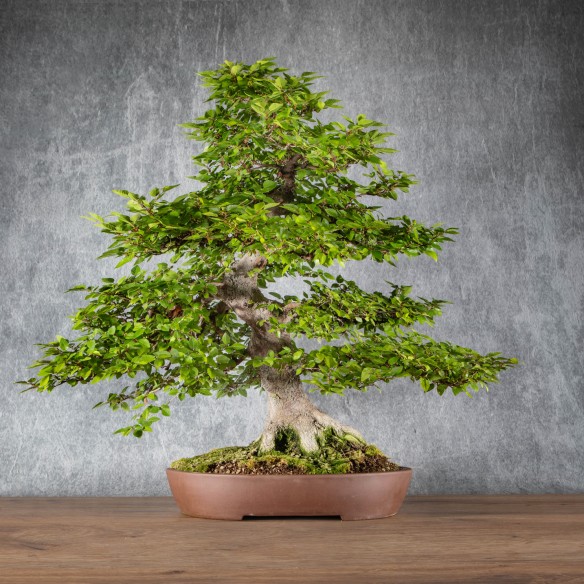


Native to the Mediterranean region, Olea europaea sylvestris, known as Wild Olive or Ullastre, is an evergreen tree highly valued in bonsai for its rusticity, twisted trunk, and compact canopy. Its small, grey-green, leathery leaves give a classic Mediterranean appearance. This species is drought-resistant and adapts well to harsh conditions.
Exhibition table not included (price per request).
Sunlight: Prefers full sun. Direct sunlight promotes trunk development, foliage compactness, and more abundant flowering.
Watering: Tolerates dry periods, but in bonsai it should be watered regularly during the growing season, allowing the soil to dry slightly between waterings. Reduce watering considerably in winter.
Humidity: Adapts to various humidity levels, ideally moderate. Occasional misting can be done during hot months.
Pruning: Pruning is essential to control growth, encourage fine branching, and maintain aesthetic shape. Can be performed during the growing season, with structural pruning in late winter or early spring.
Fertilization: Feed from spring to autumn with a balanced fertiliser or one specific for olive trees. Suspend fertilisation in winter.
Repotting: Repot every 3–4 years, preferably in early spring, using a well-draining substrate (akadama, pumice, and sand mix).
Flowering and Fruiting: Produces small fragrant white flowers in spring, followed by small green fruits that ripen into dark olives. The main ornamental value lies in the twisted trunk and compact foliage.
Data sheet
Native to the Mediterranean region, Olea europaea sylvestris, known as Wild Olive or Ullastre, is an evergreen tree highly valued in bonsai for its rusticity, twisted trunk, and compact canopy. Its small, grey-green, leathery leaves give a classic Mediterranean appearance. This species is drought-resistant and adapts well to harsh conditions.
Exhibition table not included (price per request).